|
A Wider Vision - Aspect
Ratios
by Giles Letheren
Aspect ratio is becoming more widely
talked about, particularly with the advent of high quality DVD. Most
DVD’s contain a couple of different versions of the movie, in
different aspect ratios. What is it, and why does it matter? In
simplest terms the aspect ratio of a movie is the size of hole you
look at it through, or more explicitly, the ratio between the width
and the height of that hole. If this all sounds as boring as
logarithms wait till it gets complicated.
In 1889 a engineer named W.K.L Dickinson
was working for Thomas Edison on an early type of projector known as
a Kinetograph. For reasons best known to himself, he decided that
the film to be used in the projector should be an inch wide, by
three quarter inches high. This is a ratio of 1 to ¾ or (4 by 3 as
its commonly expressed, to avoid messy fractions). As a result of
this one decision Edison and George Eastman (of Kodak fame)
established this ratio as a standard for motion pictures for over 60
years.
When televisions first started to appear
in the 1930’s most of them had round screens, which were not only
easier to produce, but could be used for Radar screens as well.
However, after the end of World War II and a drop in demand for
military round screens, engineers started to make rectangular
screens. At that time there was no reason to deviate from the
standard of 4 by 3, or the motion pictures of the day wouldn’t fit
on the television screens.
All was well until the 1950’s when, with
television starting to make serious inroads into movie audiences,
the film studios decided that they had to offer something different.
What came about was a whole host of different widescreen formats,
the first of which was the 20th Century Fox format of CinemaScope.
In this format the picture is nearly two and a half times as wide as
it is high, giving an aspect ratio of 2.35 to 1. The idea was that
by introducing a huge panoramic screen the movie theatres would be
able to provide a visual experience that television could not
compete with. The idea caught on fast and new formats started to
appear as if by magic, each promising to be grander than the next.
The ultimate point that can be reached is a 360 degree wrap-around
screen. However, by the time you try to project like this their are
enormous problems with image alignment and multiple projectors. It
just doesn’t work. Plus, who really wants to go to a movie where you
have to keep turning around to see what is happening behind you.
Nonetheless several ‘Cinema 360s’ have been built but are for the
most part left as fairground attractions designed to give you motion
sickness without the benefit of motion. Some people are very
strange.
The largest film format in current usage
is IMAX. This requires a purpose built theatre with a huge curved
screen up 90ft in diameter and steeply raked seating. The majority
of films shot in IMAX are scientific or educational. The huge
multi-channel sound systems that are installed behind and around
IMAX screens make this an all-enveloping experience. However, like
Cinema 360, IMAX is destined to be a speciality form of
movie-going.
Back in the 1970’s the competing
standards were burning out many a motor on movie screen curtains
(that have to move backwards and forward to accommodate all the
different width/height formats). Eventually, one format came to
dominate the production market and remains the system used for
shooting almost all modern ‘widescreen’ feature films - Panavision.
Like CinemaScope, this is a 2.35 to 1 format. It is also rather
expensive to make, requiring specially licensed cameras and lenses.
Also, if you want to be picky, because the widescreen film is still
shot onto 35mm film stock, the image has to be squashed up as it is
filmed to make it fit. The horribly distorted image is then
unsquashed by the lens of the projector. This can result in a
certain amount of anamorphic distortion. (Wibbly, wobbly, bendy
picture – if you want the dictionary definition).
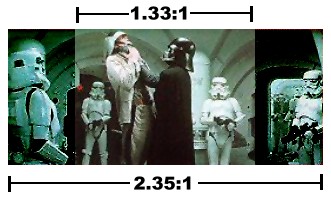
However the real problem that lies with
Panavision comes to light when you try and show a truly widescreen
film on regular television. To be fair, this is a really a problem
with television screens, not Panavision. Because you have a screen
that is 1.33 times as wide as it is high and a film that is 2.35
times as wide as it is high you lose almost half the picture.
Or as you would see it in Panavision on
TV
This is what makes the whole business of
aspect ratio important. There are two common work arounds to the
problem. You cannot just cut off half the screen as indicated above,
so a film is either ‘pan and scanned’ or ‘letterboxed’.
In pan and scan, the image that you see
on the television screen at any one time is taken from the area of
the original film with the most important action. If the lead
character is walking about, you only look at the area of the frame
that he or she is standing in. It is important to remember that at
any one time, nearly half the picture has been ‘lost’. The area of
the film negative that you view is constantly moving in the (vain)
hope you won’t miss anything important. This is the most common
television solution as to it is invisible in operation. But then
again, so is most of the picture.
Film directors hate pan and scan. It
ruins all the original composition of the film. Film extras hate it
too. They are inevitably shot on the outside edge of the negative
and consequently don’t appear in the televised film at all. The
solution to this is to show the film at its original width. In order
to that, you have to reduce the height as well to keep everything in
perspective (anamorphic distortion at play again). If you reduce the
height then there is a bit of the TV screen that has no image to
fill it and you are left with black lines at top and bottom. It
looks like you are looking at the film through a letterbox. This is
a rather sexist issue. In general, men can grasp that a smaller
picture is in fact, bigger. Women on the other hand find this hard
to believe. When you think about it, this is a pretty fair
reflection on relationships in general. Either that, or it
demonstrates the practise that men have had looking through
letterboxes.
But the story doesn’t end here. In an
attempt to keep the cost of film making down, many modern films are
shot at an aspect ratio of 1.85 to 1. This is kind of a happy medium
between true widescreen and television pictures. The main benefit
for producers is that 1.85 to 1 can be shot without special lenses
and equipment. Like Panavision it is shot on 35mm film, but this
time without special lenses. What happens here is that as the film
is shot the director ‘pretends’ he is shooting with widescreen
lenses and therefore has to ignore all the detail at the top and
bottom of the camera viewfinder. (This is marked onto the viewfinder
to make it easy). When the film is shown at a theatre, the top and
bottom of the negative are ‘matted’ out so you can’t see them. This
makes it appear that you have a widescreen print, when in actual
fact you are just looking at the middle bit of the original image.
It is letterboxing backwards. It is also the technique used in
Advanced Photo System cameras to make ‘panoramic’
pictures.
Things are still complicated when it
comes to showing a 1.85 to 1 film on a TV screen. The easiest
solution is to show the whole of the film image as it will fill the
television screen to its full size – remember it was shot onto 35mm
film at a 1.33 to 1 ratio. The director was relying on the fact that
the top and bottom of the image would be matted out to make the film
appear to be widescreen. The upshot of this is that shown full size
on a TV screen you get a whole lot of picture that you were never
meant to see. Whereas in Panavision the sides are cut off by pan and
scan, in this situation you get bonus film at the top and bottom of
the picture. Once again, this ruins the original shot composition
and will probably reveal the cameraman’s feet. As a result of this,
some movie directors are resorting to ‘hard matting’ which in
essence, is a letterbox shape stuck over the front of the camera.
That way, a TV version cannot show anything the director never meant
you to see.
The ultimate solution to all of this is
of course widescreen television. But if you make televisions wide
enough to take Panavision then ordinary TV pictures will have blank
bits at the side, as will 1.85 to 1 widescreen. Make them smaller
than this, you get black bit at the top and bottom of true
widescreen. Enter consultant mathematician Kerns Powers. Powers
worked out that the ratio that was least different to all the
competing standards was 1.77 to 1 (or 16 by 9 as it’s commonly
referred to). Like all compromise solutions it solves no problem
perfectly but seems the best you are going to get. 16 by 9 has now
become the recognised international standard for widescreen
television. The television manufactures have a number of smart TV’s
that automatically adjust the images on some widescreen TV’s to
avoid having any black bits at all. This introduces anamorphic
distortion of course and makes newsreaders look fat and film stars
like sticks, but hey, you can’t have everything.
A final thought: DVD is supposed to
provide the ultimate in video quality and is generally meant to be
watched on a television screen, be it regular size or 16 by 9.As a
'smart' 'widescreen' television distorts the letterboxed version of
a movie to make it fit full screen, the image quality suffers due to
the stretching that takes place. Some DVD releases have gone part
way to addressing this by having a version of the movie that
contains an already anamorphicaly distorted image. As the TV
stretches the image to fit, the Disc's inbuilt distortion is
corrected and you are left with a flawless, full screen and pretty
much honest interpretation of what the Director intended. This all
strikes me as being far too complicated, which neatly brings me back
to logarithms. Some things are better left for mathematicians to
play with, leaving us lesser mortals to reap the benefits without
the headaches. | 

